Invisalign vs. Braces: Which Is Better for Adults?
For most adults with mild to moderate crowding or spacing, Invisalign works about as well as braces, costs about the same, and fits far more easily into work and social life. Braces still win for severe or complex bite problems, and for anyone who knows they will not wear aligners 20 to 22 hours a day.
The right answer comes from an exam of your teeth and gums, not from the price tag.
For most adults with mild to moderate crowding, spacing, or bite issues, Invisalign is the better fit: it is nearly invisible, removable for eating and brushing, and produces results comparable to braces. Braces are the better choice for severe or complex cases, or for people unlikely to wear aligners 20 to 22 hours a day.
QUICK ANSWER
Simpler cases plus good discipline point to aligners. Complicated bites, or a history of losing retainers, point to brackets and wires.
Key Takeaways
- Research finds aligners effective for mild to moderate cases but less predictable for severe ones.
- Costs overlap, and case complexity drives the fee more than the choice of appliance.
- Aligners make brushing and flossing easier, which matters for adult gum health.
- Either way, you will need retainers afterward to keep teeth from shifting back.
Most adults who ask us about straightening their teeth have been thinking about it for years. The hesitation usually comes down to one image: a mouthful of metal in the next work meeting.
That image is out of date. Invisalign in Rancho Bernardo now handles most of the adult cases we see, though not every one, and the comparison below shows where each option comes out ahead.
How Do Invisalign and Braces Actually Differ?
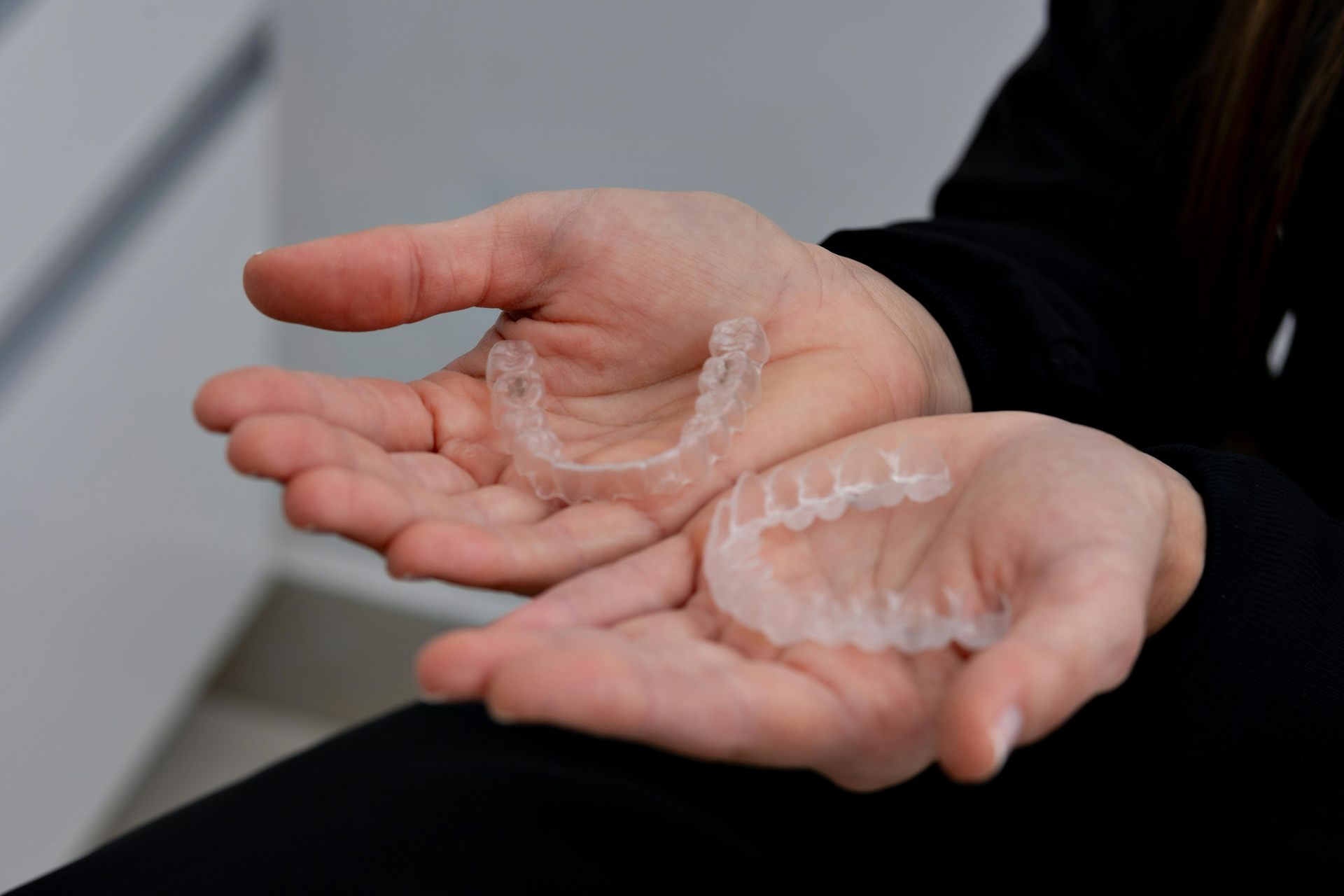
Invisalign uses a series of clear, removable trays swapped every week or two, while braces use brackets bonded to the teeth and a wire adjusted at regular visits. Both move teeth through bone the same basic way; the differences are visibility, removability, and how much control the clinician has over complex movements.
| Factor | Invisalign | Traditional Braces |
|---|---|---|
| Appearance | Clear, hard to notice | Visible metal or tooth-colored brackets |
| Is touch-up gel included or extra? | Yes, for eating and brushing | No |
| Daily wear | 20 to 22 hours | 24 hours (fixed) |
| Typical treatment time | About 12 to 18 months | About 12 to 24+ months |
| Food restrictions | None while trays are out | Avoid hard, sticky, and chewy foods |
| Best suited to | Mild to moderate cases | All cases, including severe |
Treatment times vary widely with case complexity. Ranges from
NewMouth, updated July 2026.
Which Works Better for Adult Teeth?
For mild to moderate crowding and spacing, aligners and braces produce broadly similar results. A 2022 systematic review in Clinical Oral Investigations found aligners effective for mild to moderate malocclusion but associated with weaker outcomes in severe cases, while braces remain the more predictable option for large rotations, significant bite corrections, and complex root movements.
The same review, by Yassir and colleagues, found some real advantages for aligners. Patients had better periodontal health and a lower risk of root resorption, and found aligners more comfortable to eat and chew with.
It also found one weakness worth knowing. Relapse was greater with aligners, which is one more reason retainers are not optional.
What Do Invisalign and Braces Cost for Adults?
Costs overlap more than most people expect, because case complexity and treatment length drive the fee more than the choice of appliance. A short aligner case can cost less than a long braces case, and orthodontic insurance benefits and flexible spending account funds usually apply to either option.
Align Technology, which makes Invisalign, states on its cost page that treatment is comparable in cost to braces in most cases. It also notes that dental insurance with orthodontic coverage may pay for part of it.
When you compare quotes, ask what is included:
- Records, scans, and X-rays
- Refinement aligners if teeth do not track as planned
- Your first set of retainers, and the price of replacements
- The number of in-person check-ins
Timing helps too. Many flexible spending accounts must be used by December 31, and orthodontic treatment generally qualifies, so October and November are a practical time to get a treatment plan.
Why Do So Many Adults Choose Invisalign?
Adults tend to choose Invisalign because it fits their lives: it is hard to spot in meetings and photos, it comes out for meals, and it makes brushing and flossing normal again. Adult orthodontics is also growing fast, with AAO members treating an estimated 1.9 million adults in 2024, a record for the association's survey.
That figure comes from the American Association of Orthodontists' 2024 economics survey, as reported by Becker's Dental. Align Technology says it has helped treat about 22.8 million patients, and its first-quarter 2026 results showed adult patient numbers growing 7.8% year over year.
For adults, the hygiene point carries extra weight. Gum health tends to become more of a concern with age, and being able to brush and floss normally throughout treatment is a real advantage.
When Are Braces the Better Choice?
Braces are usually the better choice for severe crowding, large rotations, significant overbites or underbites, and cases that need extensive root movement or coordination with jaw surgery. They also suit adults who know they will struggle to wear aligners consistently, because braces work around the clock whether you remember them or not.
Aligners only work while they are in your mouth. Wearing them 16 hours a day instead of 22 can stall progress and add months.
Ask yourself honestly:
- Will I put my trays back in after every meal and coffee?
- Will I keep track of them when I travel or eat out?
- Am I comfortable with a few weeks of adjusting to a slight lisp?
If any answer is no, braces may serve you better. When an exam shows your case needs brackets and wires, we will tell you so and explain your options.
What Should Adults Check Before Starting Either Treatment?
Before any orthodontic treatment, adults need a comprehensive exam with X-rays to confirm teeth and gums are healthy enough to move, and cavities, gum disease, or failing fillings should be treated first. Existing crowns, bridges, implants, and missing teeth also affect which option works and how the plan is built.
Implants are a good example. An implant cannot be moved like a natural tooth, so the plan has to work around it.
If you are gathering quotes, our guide on
how to compare Invisalign providers in San Diego covers the questions that make quotes comparable. The short version: ask about refinements, retainers, and how many cases the dentist treats.
Frequently Asked Questions
Is Invisalign or braces better for adults?
For most adults with mild to moderate crowding or spacing, Invisalign works about as well as braces and is easier to live with. Braces are more predictable for severe or complex bite problems, and for anyone who will not wear aligners 20 to 22 hours a day.
Is Invisalign faster than braces?
Sometimes: Invisalign often takes about 12 to 18 months for mild to moderate cases, while braces commonly take 12 to 24 months or more. Case complexity matters more than the appliance, and inconsistent aligner wear can make Invisalign slower.
Does Invisalign cost more than braces?
Usually not by much, because complexity and treatment length drive the fee more than the appliance. Many dental plans with orthodontic coverage apply the same benefit to either option, and flexible spending account funds can typically be used for both.
Am I too old for Invisalign?
There is no upper age limit as long as your teeth and gums are healthy, and AAO members alone treated an estimated 1.9 million adults in 2024. An exam confirms whether your bone and gums can support tooth movement.
Do I need a retainer after Invisalign or braces?
Yes, because teeth tend to drift back after any orthodontic treatment, and research suggests relapse may be greater after aligners. Most people wear a retainer nightly for the long term, so ask whether your first set is included in your quote.
Can Invisalign fix an overbite?
Invisalign can correct many mild to moderate overbites, often with small attachments and rubber elastics. Severe overbites, especially those caused by jaw position, may need braces or a combined orthodontic and surgical approach, and an exam shows which group you fall into.
Meet Your Rancho Bernardo Dentist
James Spalenka, D.D.S., F.A.G.D., has cared for patients in the San Diego area for 36 years. He is a Fellow of the Academy of General Dentistry, holds a Master's degree in Implantology, and is an Invisalign provider.
Rancho Bernardo Dentistry is at 16766 Bernardo Center Drive, Suite 105, San Diego, CA 92128. We see patients from Rancho Bernardo, 4S Ranch, Poway, Carmel Mountain Ranch, and across North County San Diego.
Find Out Which Option Fits Your Smile
Neither option is the automatic choice for adults anymore. Some patients arrive certain they want aligners and leave with a plan for braces, and the reverse happens too; the exam and X-rays usually settle it.
If you still have FSA funds this year, starting treatment before your plan year closes may let you apply them, so check your plan's deadline and any grace period.
If you are looking for a dentist in Rancho Bernardo to evaluate your smile, book an Invisalign consultation online or call (858) 293-4848.
James Spalenka, D.D.S., F.A.G.D.
16766 Bernardo Center Dr., Ste. 105 San Diego, CA 92128 USA
CALL US: (858) 487-9444
This article is general information and not a substitute for a clinical examination or personal dental advice.